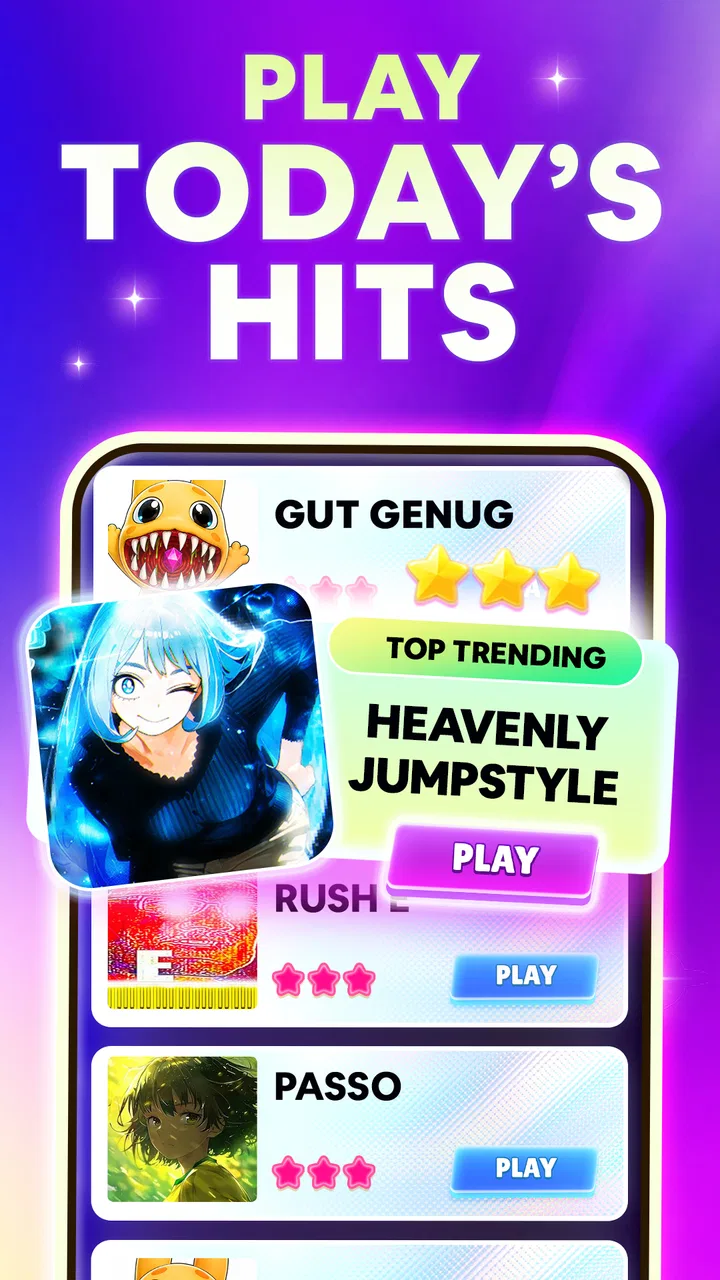
Piano Pop 2: Tiles Music Games
- 4.8
- Rating
- 5.00M
- Installs
- Free
- Price

 Analysis by App-foxy
I opened Kpop Tiles: Piano Rhythm Game expecting a simple music game, and that is exactly where its appeal begins. It puts the focus on timing: listen to the track, watch the tiles, and tap in rhythm while playing with favorite idols. The idea is easy to understand within seconds, but the difference between casually tapping and keeping a clean run becomes noticeable quickly.
This is a free music game from Rhythm Hero: Good Music Games, aimed at players who enjoy K-pop and quick touch-screen challenges. It is listed for Everyone, works on Android 7.0 or later, and has reached over one million installs. Those details matter because they place it firmly in the accessible, pick-up-and-play part of the rhythm-game category rather than the specialist end of the market.
My first impression was that it works best as a short-session game. I can play a few songs while waiting for an appointment, take another attempt after making a mistake, and stop without feeling that I have abandoned a long campaign. The K-pop theme gives those small sessions a clear identity, while the tile format keeps the controls familiar even if I have never played a rhythm game before.
You May Also Like

 Blood Strike: 2.5 Anniversary
Blood Strike’s Loadouts Turn Every Drop Into a Tactical Gamble
A close look at Blood Strike’s custom loadouts: how fast access to signature weapons reshapes its battle royale rhythm, rewards preparation, and narrows the gap between fights.

 Pandora - Music & Podcasts
Pandora’s Music Is Easy to Start, but Harder to Recover
Pandora’s strength is its low-effort path from a seed to a station. Its weak spot is how much confidence it asks you to place in connection, setup, and quiet recovery.

 8 Ball Pool
 Is Built on Rivalries, Rematches, and Routine
A close look at the rivalries, rematches, shared routines, and unanswered safety questions that turn a quick pool match into a persistent mobile community.

 Samsung Music
’s Quiet Strength Is Playing What You Already Own
Its reach comes less from spectacle than from dependable access to a personal library. That simplicity is both the app’s strongest retention engine and its ceiling.

 AccuWeather: Weather Radar
AccuWeather Review: A Quick, Clear Forecast for Everyday Decisions
For everyday plans, the best forecast is the one you can understand quickly. AccuWeather makes rain timing, radar, and local conditions easy to act on, with a few trade-offs.

 Hill Climb Racing
Why Hill Climb Racing Still Turns Crashes Into One More Run
A tiny car, a bumpy hill and one more upgrade: Hill Climb Racing keeps resurfacing because its simple chaos makes every near-miss feel personal.
More From Our News Desk



How the current version feels to play
The core loop is straightforward: a song starts, tiles move toward the input area, and I tap along with the beat. The challenge comes from maintaining concentration as the music continues. A song can feel comfortable during its opening moments and then demand much more attention once the pattern becomes faster or less predictable.
I like that the game does not require me to learn a complicated control scheme. There is no need to memorize several gestures before starting. That makes it a natural recommendation for someone who wants a music-themed game rather than a full simulation of playing piano. It also makes the experience suitable for younger players, although an adult may eventually want more depth than the basic tapping format provides.
The strongest part of the design is the connection between visual movement and sound. When I stop looking at the tiles and rely only on the music, I make mistakes; when I stare at the screen without feeling the rhythm, I also lose accuracy. The game rewards using both kinds of attention. That gives each replay a practical purpose: I am not simply repeating a song, but trying to improve the way I read its timing.
One useful habit is to treat the first attempt as a calibration round. Instead of chasing a perfect result immediately, I watch for where the pattern changes and notice whether my taps are landing early or late. On the next run, I can focus on that specific section. This approach makes the game feel less random and turns short retries into a modest practice routine.
The K-pop setting is more than a label placed around a generic piano game. It changes why I return. Recognizing a style of song or wanting to play with a particular idol gives me a reason to choose one track over another. Players who already follow K-pop will probably get more emotional value from the presentation than people who are only interested in abstract rhythm challenges.
Who will enjoy the format
I would point this game toward casual K-pop listeners, younger players, and anyone who enjoys improving through repeated attempts. It is also a good fit for people who prefer touch controls over virtual buttons. The basic interaction is immediately readable, so a friend can pick up the phone and understand the objective without a long explanation.
A realistic everyday use case is a short commute or a break between tasks. I can play one song, notice a difficult passage, and use a second attempt to work on that passage without committing to a lengthy session. The game is especially convenient when I want something more active than listening to music but less demanding than a strategy or action game.
It is less suitable for someone searching for a serious piano-learning tool. Tapping falling tiles can improve reaction and timing, but it does not replace learning notes, hand position, scales, or musical technique. Likewise, a player who wants extensive customization, deep progression, or a competitive rhythm-game system may find the compact format limiting.
What the version and release context tell me
The game was released on July 16, 2025, and the current version is 1.5.0. I see that version number as a sign that the product has already moved beyond its first launch build, but I would not treat it as proof of a particular feature or overhaul. What I can judge directly is the current experience: it is centered on accessible K-pop tile tapping, quick retries, and unlocking additional songs as I continue playing.
That distinction is important. A newer version can indicate ongoing development, but it does not automatically mean the game has the depth of a long-established rhythm title. In this case, I would approach it as a developing casual game whose present identity is clear, rather than expecting a mature platform with every advanced option from the beginning.
The public response is encouraging without removing the need for personal testing. The game holds a 4.6 average from around twenty-three thousand ratings, with more than one hundred written reviews. I read that as evidence that the central idea works for many players, not as a guarantee that every device, song preference, or playing style will feel equally satisfying.
It is also free, which lowers the barrier to trying it. I can install it without first deciding whether a purchase is justified. That is valuable for a music game because enjoyment depends heavily on whether the available song selection and visual style match my taste. The sensible approach is to try several sessions before deciding whether it deserves a permanent place on the phone.
How existing players may experience the evolution
For someone who started near launch, version 1.5.0 should be understood as the current point in the game’s development rather than a completely different product. The basic reason to play remains recognizable: tap to the beat, pursue better runs, and unlock more K-pop songs. Existing users who liked that loop will probably appreciate continuity more than a radical change.
New players benefit from entering at a later stage because they can judge the game as it stands today instead of comparing it with an early build. That makes the first few sessions easier to evaluate: do the songs hold attention, do the controls feel responsive, and does the unlocking structure give enough motivation to continue? Those are more useful questions than simply asking how long the game has existed.
My advice to returning players is to revisit songs they previously found uncomfortable rather than only chasing new content. Familiar tracks reveal whether my timing has improved, while new songs test whether that improvement transfers. This is one of the less obvious strengths of the format: a small music game can still provide a personal progression path if I use each replay deliberately.
Another practical tip is to play with a consistent grip and screen position. Because the interaction is based on precise taps, changing how I hold the phone can make a difficult section feel harder than it really is. I get more reliable results when the device is stable and my tapping hand is not covering the area I need to read.
Where the experience still has limits
The simplicity that makes the game welcoming also creates its main limitation. Tapping tiles is easy to learn, but the format may not offer enough variety for players who need frequent mechanical changes. If I want a game built around several note types, complex patterns, or a large competitive ecosystem, a more specialized rhythm title would probably suit me better.
The song-unlocking structure gives me a reason to keep playing, but it also means the available content matters a great deal. A player can enjoy the first sessions and still lose interest if the music selection does not match their personal K-pop preferences. I would not recommend choosing this solely because of the genre label; the actual appeal depends on whether the featured style keeps you interested during repeated attempts.
There is also a difference between recognizing a song and enjoying it as a rhythm chart. A familiar track may be exciting, yet its tile pattern may not challenge me in an interesting way. Conversely, a less familiar song may turn out to be more enjoyable because its timing creates a satisfying test. I try to separate music preference from chart quality when deciding which songs deserve another attempt.
Players should also keep expectations realistic about the age rating. Everyone makes the game broadly approachable, but that does not mean every player will find it equally deep. The rating tells me the intended accessibility of the content; it does not promise advanced musical instruction or a feature-rich experience for expert rhythm players.
Comparing it with familiar alternatives
Compared with a standard piano-tile game, this one has a clearer K-pop identity. The music theme and idol-focused presentation give me more motivation than an anonymous sequence of notes. If my main reason for playing is to connect a quick challenge with K-pop, this is the more natural choice.
Compared with a conventional music-streaming app, it is obviously more interactive. I am not just hearing a track in the background; I am responding to its rhythm and accepting the possibility of failure. That makes it a better choice when I want active entertainment, but a worse choice when I simply want uninterrupted listening or a relaxed playlist.
Compared with a deeper rhythm game, the trade-off is accessibility. Kpop Tiles is easier to understand and faster to start, while a specialist alternative may offer more modes, stronger long-term mastery, or more demanding chart design. I would choose this game for convenience and theme, not because I expect it to replace every other rhythm experience.
It also differs from a piano-learning app in purpose. A learning app should explain musical concepts and build technique step by step. This game is about timing, reaction, and entertainment. Someone deciding between the two should ask whether the goal is to play along with K-pop for fun or to develop transferable keyboard skills. For the first goal, this game makes sense; for the second, another category is better.
Small strategies that improve the experience
I found three habits particularly useful. First, I avoid starting with the hardest available challenge when I am still learning the game’s visual rhythm. A comfortable song helps me understand the timing window and the way the screen communicates upcoming taps. Once that feels natural, a more demanding track becomes a meaningful test instead of a confusing first impression.
Second, I use failed runs as information. If I miss repeatedly in one area, I ask whether I am watching the wrong tile, tapping ahead of the beat, or letting the previous note distract me. That diagnosis is more effective than simply tapping faster. The game’s compact controls make this kind of self-correction possible because there are not many other systems competing for attention.
Third, I separate discovery sessions from improvement sessions. During discovery, I sample songs and decide which ones fit my taste. During improvement, I return to one selected track and concentrate on consistency. Mixing both goals can make progress feel unclear, while separating them gives each short play session a purpose.
These habits also reveal a trade-off. The game can become surprisingly absorbing when I treat it as a timing exercise, but it asks me to supply some of the structure myself. Players who prefer a clearly explained training ladder may want more guidance than the current format provides. Players who enjoy setting their own small targets may appreciate that freedom.
What I would watch as development continues
The most important thing I would watch is how the song library develops. Since unlocking additional K-pop songs is central to the loop, continued variety will determine whether the game remains interesting after the novelty of the first sessions fades. More songs would be useful only if they also provide different rhythmic experiences rather than feeling interchangeable.
I would also pay attention to whether future updates deepen the relationship between idols, songs, and progression. The theme already gives the game its strongest identity, so thoughtful use of that identity could make returning feel more personal. At the same time, changes should preserve the quick-start quality that makes the game approachable in the first place.
For current players, the practical question is not whether the game has reached a final form. It is whether version 1.5.0 already provides enough enjoyable music sessions for their own habits. If you like K-pop, prefer short touch-based challenges, and do not need a full competitive system, the answer is likely yes. If you want a broad rhythm-game toolkit or genuine piano instruction, I would look elsewhere.
My overall view is positive but measured. This is a focused K-pop tapping game, not a replacement for a piano course or a heavyweight rhythm platform. Its strengths are immediate controls, a recognizable music identity, free access, and a loop that fits naturally into spare moments. Its weakness is the same simplicity that makes it inviting: dedicated players may eventually want more depth and variety.
I would recommend giving it a try if you want an easy way to make K-pop listening more active. Start with a few songs, pay attention to how the timing feels on your device, and decide whether unlocking more tracks gives you a real reason to return. With an Everyone rating, support for Android 7.0 and later, and a current release that has already attracted over one million installs, it is easy to sample. Just choose it for quick rhythm fun and idol-themed music play, not for features it was never designed to provide.
In the end, Rhythm Hero: Good Music Games has made a sensible choice by keeping the central interaction clear. I can understand the game immediately, improve through repetition, and connect each attempt to a song I want to hear. That is enough to make it worthwhile for casual K-pop fans, provided they are comfortable with a focused experience whose long-term value depends heavily on the music and continued development.
FAQs for Piano Pop 2: Tiles Music Games
01What is Kpop Tiles: Piano Rhythm Game?
Kpop Tiles: Piano Rhythm Game is a music-based mobile game that combines the thrill of piano tiles with your favorite Kpop hits. Players tap on the glowing tiles in rhythm with the music, providing an engaging and challenging experience. The game features a variety of songs from popular Kpop artists, making it a must-play for fans of the genre.
02Is Kpop Tiles: Piano Rhythm Game free to play?
Yes, Kpop Tiles: Piano Rhythm Game is free to download and play. However, while the core experience is accessible without cost, the game may offer in-app purchases. These purchases can include additional songs, ad removal, or other enhancements to improve the gaming experience. Players can enjoy the game fully without spending money, but optional content is available.
03What platforms is Kpop Tiles: Piano Rhythm Game available on?
Kpop Tiles: Piano Rhythm Game is available on both Android and iOS platforms. This means you can download it from the Google Play Store for Android devices or the Apple App Store for iOS devices. The game is optimized for seamless performance on a wide range of smartphones and tablets, ensuring a great experience for all users.
04How can I improve my skills in Kpop Tiles: Piano Rhythm Game?
Improving your skills in Kpop Tiles: Piano Rhythm Game takes practice and patience. Start with slower songs to develop your timing and rhythm. Gradually progress to faster tracks as you become more comfortable. Utilize practice modes if available, and replay levels to perfect your performance. Consistent practice is key to mastering the game.
05Does Kpop Tiles: Piano Rhythm Game require an internet connection?
Kpop Tiles: Piano Rhythm Game can be played offline, allowing you to enjoy it without an internet connection. However, certain features, like downloading new songs or accessing online leaderboards, may require a connection. It's a great option for playing on the go, even in areas where internet access is limited.
Pros
- Intuitive controls make it easy to play.
- Wide variety of K-pop songs available.
- Regular updates with new tracks.
- Engaging visuals enhance gameplay.
- Offline play mode available.
Cons
- Occasional ads disrupt gameplay.
- Some songs require in-app purchases.
- Limited customization options.
- High battery consumption reported.
- Leaderboard sometimes glitches.

Piano Pop 2: Tiles Music Games
Gallery